English


















































































































































































































































































































































































































































































































Inflated claims, policy flaws cast shadow on J&K industrial land allotment merit list



Srinagar, Apr 13: Serious questions have been raised over the fairness and credibility of the industrial land allotment process in Jammu and Kashmir, with stakeholders alleging that inflated projections and structural flaws have distorted the recently issued provisional merit list.
The Directorate of Industries and Commerce, through notification dated April 9, 2026, placed the provisional merit list in the public domain following a High-Level Land Allotment Committee meeting held on March 18, 2026, inviting objections till April 19. While the list has been prepared under Government Order No 65-IND of 2021 governing the J&K Industrial Land Allotment Policy 2021-30, its implementation has triggered widespread concern among stakeholders.
The policy envisages an objective and transparent framework by evaluating applications across nearly 15 parameters, including proposed investment, employment generation, land utilisation efficiency, pollution category, MSME classification, and other socio-economic considerations. However, while the intent of the policy appears sound, its design and application, as reflected in the provisional merit list, raise serious concerns that strike at the very root of fairness and credibility.
At the core of the evaluation framework lies a disproportionately weighted scoring system, where nearly 80 percent of the total score is derived from two parameters – investment per kanal and employment per kanal.
What appears rational in theory has, in practice, created a deeply flawed incentive structure.
The provisional merit list reveals multiple instances where applicants have claimed extraordinarily high employment figures on very small land parcels.
Cases of units projecting over 100 employments per kanal, and even micro units claiming employment comparable to medium-scale enterprises, are not isolated aberrations but recurring patterns.
Such projections defy sectoral realities and expose a fundamental weakness in the system – the policy rewards declarations, not demonstrated feasibility.
Since scores are derived directly from self-reported DPRs without rigorous technical validation or sectoral benchmarking, applicants are incentivised to inflate employment and efficiency figures to secure higher rankings.
In this process, genuine entrepreneurs presenting realistic and achievable projections are placed at a clear disadvantage, while exaggerated claims gain an artificial edge.
The problem is further compounded by the uniform application of these criteria across vastly different sectors.
Industrial activity is inherently diverse – labour intensity, land requirements, and operational dynamics vary significantly between IT services, manufacturing, healthcare, cold storage, and heavy industry. Yet, the policy applies a single evaluative grid, particularly the “employment per kanal” metric, across all sectors.
This results in distorted comparisons where fundamentally incomparable activities are judged by identical standards.
The emphasis on per kanal efficiency also tilts the balance disproportionately in favour of smaller land seekers, often at the cost of larger, capital-intensive projects that may generate greater long-term economic value but naturally exhibit lower employment density ratios.
In doing so, the policy risks privileging short-term numerical advantage over sustainable industrial development.
Equally concerning is the absence of any credible mechanism for post-allotment accountability.
If inflated projections are allowed to influence allotment decisions at the outset, there is little assurance that these commitments will translate into actual investment or employment on the ground. The system, as it stands, neither penalises overstatement nor rewards delivery, thereby weakening the very discipline that such a framework is expected to enforce.
The present merit list, therefore, is not merely a compilation of applications – it is a reflection of structural infirmities in policy design and its implementation.
It underscores the urgent need for course correction through independent technical appraisal of DPRs, sector-specific benchmarking, normalisation of extreme values, and a phased verification mechanism linking land retention to actual performance. Greater weightage must also be accorded to financial closure, track record, and project viability rather than purely notional projections.
The concerns extend beyond scoring methodology into the broader planning approach.
The government’s initiative to develop sector-specific industrial estates, particularly for IT, ITES, and education at locations such as Rakh-e-Gund Aksha (Bemina) and Khunmoh (Phase-IV), reflects a forward-looking vision of creating integrated ecosystems.
However, the same clustering logic, when extended to healthcare under the concept of a “Medicity,” raises serious questions of viability and public utility.
Healthcare, unlike IT or education, is fundamentally demand-driven and location-sensitive.
The concentration of hospitals, diagnostic centres, and medical institutions at limited locations such as Bemina and Lelhar risks creating unhealthy competition, underutilisation of infrastructure, duplication of services, and most importantly, inequitable access for large sections of the population.
In a region where geography and connectivity already pose challenges, such centralization may undermine the very objective of improving healthcare access.
Public policy, particularly in critical sectors like healthcare, must prioritise spatial distribution over administrative convenience. A more balanced approach would have ensured wider outreach, better service delivery, and sustainable demand across regions rather than concentrating facilities in isolated clusters.
Ease of Doing Business is not merely about procedural transparency or numerical scoring – it is about fairness, credibility, and trust in institutional processes.
When policies incentivise exaggeration and fail to distinguish between intent and capability, they risk eroding that trust.
The window for objections to the provisional merit list is, therefore, not a routine procedural step.
It is an opportunity to correct systemic distortions and restore integrity to the land allotment framework.
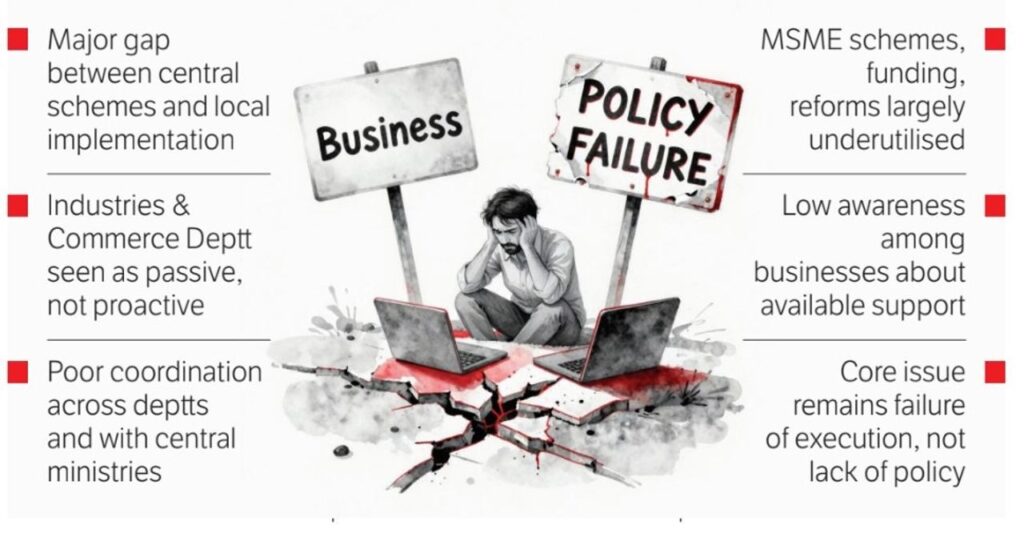
Without such correction, the policy risks becoming yet another example where well-intentioned design is undermined by flawed execution, leaving both industry and governance diminished in the process.